How Electric Toothbrushes Have Changed Over the Years
Electric toothbrushes may seem like a fairly modern invention, especially now that some models connect to mobile apps, track brushing habits and use artificial intelligence to point out missed areas.
In reality, powered toothbrushes have existed for more than 60 years.
What has changed is not simply how fast the brush moves. Over time, electric toothbrushes have become smaller, safer, quieter and easier to use. Their purpose has also changed. The earliest models mainly helped people who struggled to use a manual toothbrush, while modern designs increasingly act as personal brushing coaches.
Dental experts generally agree that the best electric toothbrush is not necessarily the one with the most features or the highest number of movements per minute. What matters most is whether it helps someone brush gently, thoroughly and consistently.
The first electric toothbrushes were bulky machines
One of the earliest commercially successful electric toothbrushes was the Broxodent, developed in Switzerland during the 1950s and introduced to the American market around 1960.
It was originally intended for people with limited hand movement and patients wearing braces. Unlike modern cordless brushes, the Broxodent had to be plugged into an electrical outlet while being used.
General Electric introduced a cordless rechargeable toothbrush shortly afterwards, in 1961. This made electric brushing more convenient, but the technology still had serious limitations. The handles were bulky, the batteries did not last very long and the sealed rechargeable batteries could not easily be replaced. Once the battery failed, the entire toothbrush often had to be discarded. (MedCrave Online)
These early toothbrushes were useful mechanical aids, but they were far from the slim, lightweight products found in bathrooms today.
Smaller batteries and motors changed the design
As rechargeable batteries and electric motors became smaller, manufacturers were able to make electric toothbrushes more comfortable and practical.
This led to the two main types of electric toothbrushes still widely used today.
Oscillating-rotating toothbrushes
An oscillating-rotating toothbrush usually has a small, round brush head. The head rapidly turns in one direction and then the other.
Instead of scrubbing across several teeth at once, the user slowly guides the brush from tooth to tooth and allows the moving head to do most of the work.
The small head can make it easier to clean individual teeth and reach awkward areas near the back of the mouth.
Sonic toothbrushes
A sonic toothbrush normally has a longer, oval-shaped head that looks more like a traditional manual toothbrush.
Its bristles move rapidly from side to side, often making tens of thousands of movements per minute. The user gently guides the brush around the teeth and along the gumline rather than scrubbing forcefully.
Because the shape feels familiar, sonic toothbrushes are often an easy transition for people who have always used a manual toothbrush.
Both designs can clean effectively when used correctly.
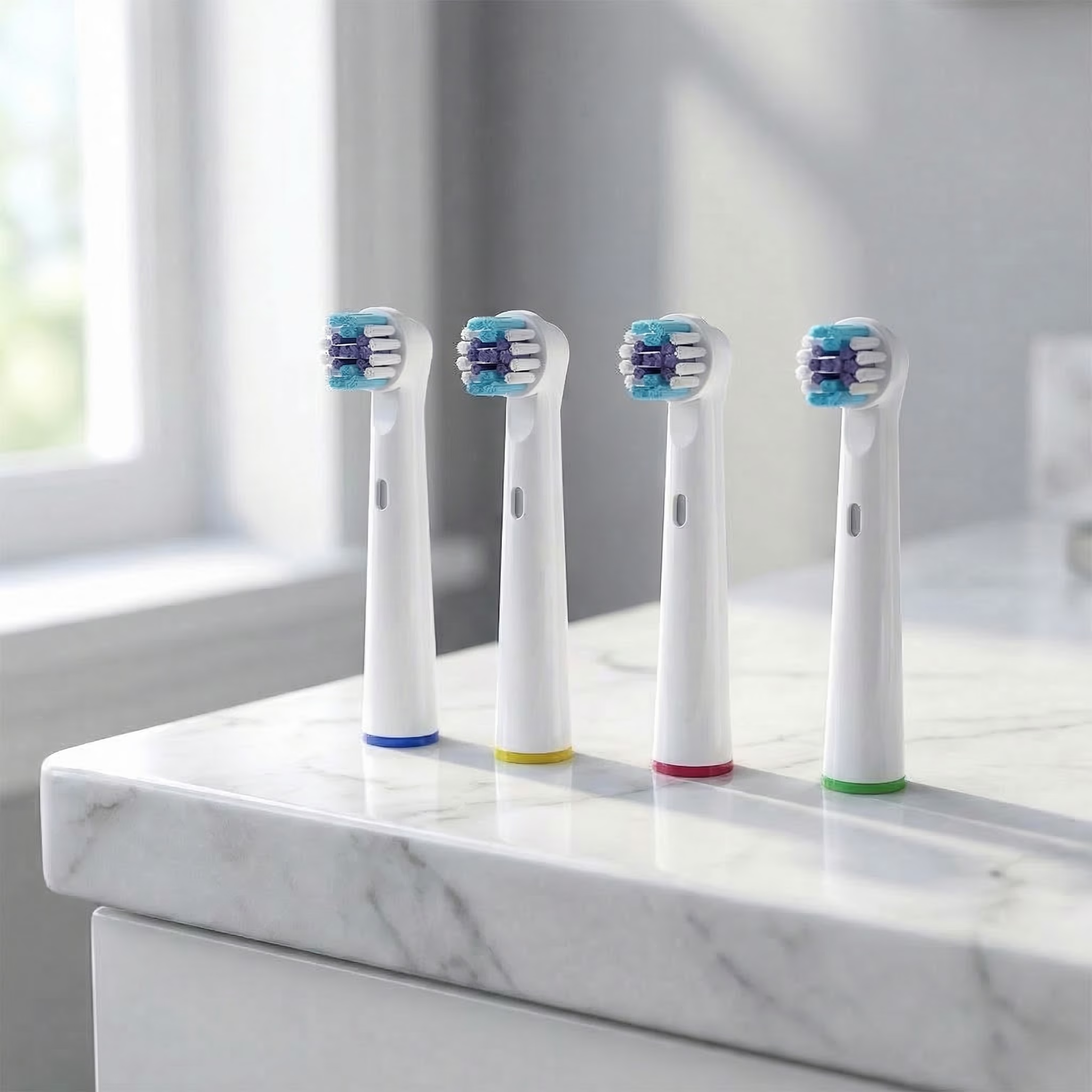
Replaceable brush heads made electric toothbrushes more practical
Another major improvement was the introduction of replaceable brush heads.
Instead of replacing the entire toothbrush when the bristles became worn, users could keep the rechargeable handle and replace only the head.
This made electric toothbrushes more economical and allowed manufacturers to produce different brush heads for different needs, such as sensitive gums, orthodontic care, whitening or cleaning around dental work.
Most dental guidance recommends replacing a brush or brush head approximately every three to four months, or sooner when the bristles become frayed or worn. (American Dental Association)
The toothbrush became a brushing coach
During the 2000s and 2010s, electric toothbrush design began moving beyond simply making the bristles move.
Manufacturers added features such as:
- Two-minute timers
- Signals every 30 seconds
- Pressure warnings
- Sensitive brushing modes
- Battery indicators
- Travel locks
- Motion tracking
- Bluetooth connections
- Mobile applications
These additions changed the role of the electric toothbrush. It was no longer only helping with the physical brushing movement. It was also trying to improve the user’s technique and consistency.
A timer helps solve one of the most common brushing problems: stopping too early. The general recommendation is to brush twice a day for two minutes using a soft-bristled toothbrush. Built-in timers and 30-second pacing signals help users divide their brushing time evenly between the four areas of the mouth. (American Dental Association)
Pressure warnings address another common mistake. Many people assume that pressing harder will clean their teeth better. In reality, brushing too aggressively can irritate the gums and may contribute to gum recession over time. The goal is controlled, gentle brushing rather than forceful scrubbing. (ADA News)
Do electric toothbrushes clean better?
Research generally shows that powered toothbrushes provide a small but measurable advantage over manual toothbrushes.
A major Cochrane review concluded that electric toothbrushes reduced plaque and gum inflammation more effectively than manual toothbrushes in both the short and long term. The researchers also noted that the real-world significance of the difference was not completely clear. (Cochrane)
A manual toothbrush can still clean teeth effectively when someone uses the correct technique and brushes consistently.
The advantage of an electric toothbrush is that it makes good technique easier. The motor creates a consistent movement, while features such as timers and pacing signals reduce the guesswork involved.
Electric brushes can be particularly helpful for:
- People with limited hand movement
- Older adults
- Children who struggle with brushing technique
- People wearing braces
- People with disabilities
- Anyone who tends to brush too quickly or inconsistently
The American Dental Association states that both manual and powered toothbrushes can be used effectively. (American Dental Association)
Is a sonic or rotating toothbrush better?
There is still some debate about which electric toothbrush movement is best.
A 2026 network meta-analysis of 19 clinical trials ranked oscillating-rotating toothbrushes first for reducing plaque, followed by sonic toothbrushes. A similar pattern was found for reducing gingivitis. (Springer Link)
Other research has also found that oscillating-rotating designs may have a slight advantage over sonic and manual toothbrushes. (PubMed)
Both designs can work well, and the difference between them is often less important than whether the user:
- Brushes twice a day
- Brushes for the full two minutes
- Reaches every surface
- Uses gentle pressure
- Replaces worn brush heads
- Uses fluoride toothpaste
A sonic toothbrush that someone enjoys using every day is a better choice than a technically superior toothbrush that feels uncomfortable and stays on its charging stand.
What designers now believe matters most
Modern electric toothbrush design is gradually moving away from the idea that more speed, more power and more settings automatically produce a better clean.
The current focus is on comfort, control and consistent use.
Gentle brushing is better than aggressive brushing
A good electric toothbrush should help the user clean effectively without encouraging excessive pressure.
Soft bristles, controlled movement and a comfortable brushing sensation are more important than making the toothbrush feel extremely powerful.
Pressure indicators can be valuable because they warn users when they are pushing too hard. Sensitive modes can also help people with tender gums or sensitive teeth, although most people do not need a large collection of specialised settings.
The handle must be easy to control
Handle design matters, particularly for people with arthritis, disabilities or reduced hand strength.
A comfortable, non-slip handle may be more useful than an expensive screen or smartphone application. The handle should feel secure without requiring a tight grip.
The brush head should also be small enough to move around the back teeth and along the gumline. A toothbrush cannot clean an area that the user cannot comfortably reach.
Timers are more useful than most smart features
For most people, the most valuable electronic features are relatively simple:
- A reliable two-minute timer
- A 30-second quadrant pacer
- A pressure warning
- A clear battery indicator
Mobile applications can help some users develop better routines or identify areas they regularly miss, but an app only provides value when the person actually uses the feedback.
Technology is valuable when it corrects a genuine brushing problem. Features added mainly to make the product appear more advanced may not improve oral health.
New toothbrush shapes still need proper testing
Some newer toothbrushes use U-shaped mouthpieces that claim to clean every tooth at the same time.
The idea is attractive because it appears faster and easier than moving a brush around the mouth. However, the effectiveness varies considerably between products.
A 2020 clinical trial found that the particular U-shaped automatic toothbrush tested was not effective at removing plaque. (PMC)
A different U-shaped toothbrush range has since received the American Dental Association’s Seal of Acceptance after demonstrating that it could safely remove plaque and help reduce gingivitis when used as directed. (American Dental Association)
This shows why consumers should be cautious about judging a toothbrush by its appearance or advertising. A new shape is not automatically an improvement. Each product needs to be assessed on its own evidence.
Sustainability is becoming part of toothbrush design
Electric toothbrushes allow the main handle to be reused, but they still contain plastic, metal, electronic components and rechargeable batteries.
A life-cycle study comparing four representative toothbrush types found that the electric toothbrush examined had the greatest environmental impact in 15 of the 16 categories measured, considering manufacturing, materials, transport, use and disposal over five years. (UCL Discovery)
This does not mean that every electric toothbrush has exactly the same environmental impact. What it does show is why durability matters.
From a sustainability point of view, it makes sense to choose a toothbrush with:
- A durable rechargeable handle
- A battery designed to last several years
- Readily available replacement heads
- Minimal unnecessary packaging
- A reliable warranty
- Repair or recycling options where available
Keeping one electric toothbrush for several years is more sensible than replacing the entire device whenever a newer model appears.
What should you look for in an electric toothbrush today?
A sensible modern electric toothbrush does not need to be complicated.
Look for a brush with:
- Soft, good-quality bristles
- A comfortable handle
- A proven sonic or oscillating movement
- A two-minute timer
- A 30-second pacing signal
- Easily available replacement heads
- Reliable battery life
- A pressure warning, where possible
- A design that is easy to clean
Additional modes, screens and applications are personal preferences rather than essential requirements.
The most important question is not how many features the toothbrush has. It is whether the design makes it easier for you to brush correctly every morning and evening.
Looking for a good electric toothbrush?
If you are looking for a straightforward sonic toothbrush with useful everyday features, the Dr Smile Electric Toothbrush with Charger is a practical option available from Smilerite.
The toothbrush produces up to 31,000 strokes per minute and includes four brushing modes: Clean, White, Polish and Sensitive. It also has a two-minute smart timer, a 30-second pacer, a memory function and an inductive USB charging base.
Its IPX7 waterproof design makes the handle suitable for normal bathroom use, while the rechargeable battery removes the need for disposable batteries. The brush is available in Pearl White and Midnight Black. (Smilerite)
Compatible Dr Smile replacement heads are sold separately in packs of two. The heads use high-density soft bristles and are available in colours matching the toothbrush handle. (Smilerite)
The Dr Smile toothbrush and its replacement heads can be ordered directly from Smilerite, with delivery available throughout South Africa.
The best toothbrush is the one you use properly
Electric toothbrushes have evolved from bulky, plug-in medical aids into compact devices that combine mechanical cleaning with behavioural guidance.
Despite all of this technology, their basic purpose has not changed. A toothbrush still needs to remove plaque without damaging the teeth or gums, and it needs to be comfortable enough that someone will use it properly every day.
A reliable electric toothbrush used for two minutes twice a day will generally outperform an expensive smart toothbrush left unused on its charging stand.
Ready for a Brighter Smile?
Our dental experts are here to help you choose the perfect products for a healthy, radiant smile.